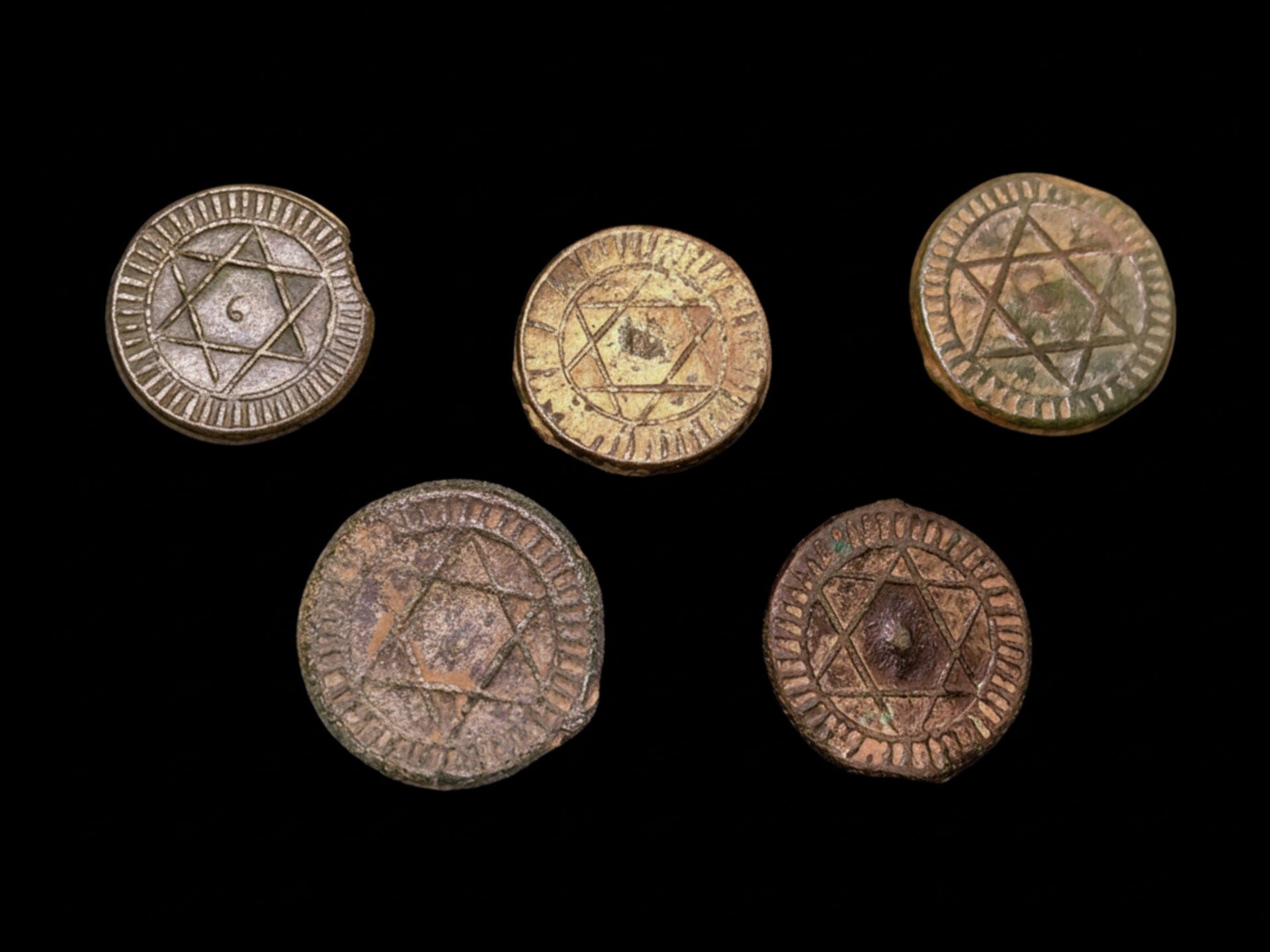
Les falus du XIXᵉ siècle
Fermez les yeux un instant, et imaginez un souk marocain au XIXᵉ siècle. Le bruit des voix, l’odeur des épices, le cuivre qui s’échange de main en main. Dans cette effervescence, circulent de petites pièces appelées falus. Simples, fragiles, elles portent le sceau du royaume.
Sous les règnes des sultans Sidi Mohammed IV (1859–1873) et Moulay al-Hasan I (1873–1894), certaines de ces monnaies furent frappées d’une étoile à six branches. Aujourd’hui, ces modestes objets, usés par le temps, nous apparaissent comme des témoins silencieux d’une époque révolue.
Un symbole partagé par trois religions
Cette étoile n’était pas un motif anodin.
- Pour le judaïsme, elle était déjà, depuis le Moyen Âge, le Magen David, l’étoile de David, devenue le cœur identitaire et spirituel d’un peuple.
- Dans le christianisme médiéval, on la voyait illuminer vitraux et manuscrits, figure d’harmonie divine.
- Dans l’islam, on la connaissait comme le sceau de Salomon (khatam Sulayman), signe de sagesse et de protection associé au roi-prophète Souleïmane.
Ainsi, lorsqu’elle fut gravée sur les monnaies marocaines du XIXᵉ siècle, l’hexagramme portait déjà une résonance profondément juive, tout en étant compris et honoré dans les autres traditions.
La place des Juifs au Maroc
Au XIXᵉ siècle, la communauté juive était enracinée depuis des siècles dans la vie marocaine. On la retrouvait surtout dans les mellahs des grandes villes, au cœur du commerce et de la diplomatie.
Certains Juifs servaient comme interprètes ou conseillers du sultan ; d’autres appartenaient aux Tujjār as-Sultān, une élite de négociants placés sous patronage royal et chargés d’ouvrir le Maroc au commerce international. Leur rôle illustre la confiance et l’importance accordées à cette communauté, dont la contribution au rayonnement du royaume était largement reconnue.
Dans ce contexte, voir une étoile de David circuler sur une pièce de monnaie d’État ne pouvait qu’avoir une résonance particulière. Gravée dans le cuivre du pouvoir, elle offrait à la communauté juive un signe discret mais précieux de visibilité et de reconnaissance.
Des reliques précieuses
Ces pièces sont aujourd’hui de véritables reliques. Leur rareté attire les collectionneurs et les historiens, mais leur valeur la plus profonde est ailleurs : elles rappellent un temps où le judaïsme marocain faisait partie intégrante de la société, et où son symbole le plus intime circulait dans les mains de tous.
Fermez les yeux : vous êtes un Juif marocain du XIXᵉ siècle. Dans votre paume repose une pièce de cuivre où scintille votre étoile. Un geste banal d’échange, mais soudain chargé d’une dignité silencieuse. Comme si la mémoire s’était glissée dans le métal pour ne plus jamais disparaître.
Une continuité vivante
Le Maroc porte encore aujourd’hui cette mémoire. Après l’expulsion d’Espagne en 1492, des milliers de Séfarades y avaient trouvé refuge, enrichissant la culture, l’économie et la spiritualité du royaume. Synagogues restaurées, mellahs préservés, musées et pèlerinages rappellent cette histoire plurimillénaire, l’une des plus riches du monde musulman.
Une grande partie des Juifs marocains vit désormais en Israël, et les liens entre les deux pays, renforcés récemment par les Accords d’Abraham (2020), prolongent cette mémoire commune. Ce rapprochement n’est pas seulement diplomatique : il résonne comme la continuité d’une histoire partagée, entre peuples, traditions et générations.
Un choix symbolique
Ce n’est pas un hasard si les Tikkun Box naissent au Maroc. Dans cette terre, l’histoire, la mémoire juive et l’artisanat se rejoignent comme nulle part ailleurs. C’est là que l’étoile de David a brillé jusque sur la monnaie du royaume ; c’est là qu’aujourd’hui, entre les mains des artisans, les coffrets In Living Memory trouvent leur légitimité et leur âme.
Ajouter un commentaire
Commentaires